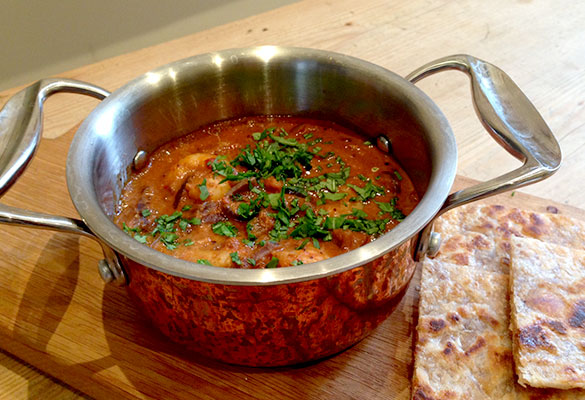
Prawn, coconut & tamarind curry

Posted in: DF, S, SF, WF

A healthy, tangy and creamy curry to help you on your way to summer body. That’s right, curry needn’t be laden with ghee and consumed only in the early hours. In fact, the spices and coconut oil in this recipe are even good for your gut. I’ve used prawns for a potentially wider appeal, but I also make this with any white, sustainable fish as a less extravagant mid week supper.

Prawn,-coconut-&-tamarind-curry
Feeds 4

INGREDIENTS

2″ piece ginger
2 red chillies
4 cloves garlic
6 tsp coriander seed, toasted and ground
1 tin tomatoes or 6 ripe tomatoes

1 tbsp coconut oil
2 onions
3 tsp tamarind paste
1 dsp Agave syrup
1 x 400ml can coconut milk or coconut powder if you can get it.
1 tsp sea salt
500g raw, shelled, uncooked tiger prawns or white sustainable fish, deboned.
1 tbsp coriander leaves, chopped

METHOD

In a blender, blitz ginger, garlic, chillies, tomatoes and coriander seeds to make rough paste. Depending on how many I’m cooking for, I often leave half aside at this point to make a fresh curry another day. If you’re going the whole hog, however, use the lot.

Heat coconut oil in heavy based pan, chop onions and fry on medium to low heat until they’re translucent.

Add your tomato paste to the onions and cook for 5 mins, stirring intermittently. Follow with tamarind, Agave, coconut milk or powder and sea salt. Cook on a medium heat for 10 mins.

Check for seasoning, put the prawns or fish into the pan, stir and cook gently for 3 – 4 mins, or until meat is cooked through.

Serve with brown rice, roti or wholemeal paratha and chopped coriander. I also like this on it’s own for supper, effectively as a chunky soup… when carb baby needs curbing.

Coconut-powder

Tip: Tinned coconut milk can vary widely in flavour from the real thing, often altering the curry considerably. Even if fresh coconuts were readily available in the UK, however, I’m not about to start tackling them. So, I was very pleased to come across coconut powder in the world food isle, which somehow tastes far more authentic. You just add to the curry, diluting with water to your taste. Frozen roti and paratha are pretty easy to come by in most supermarkets too.

Tip: Don’t throw away coriander stalks. Instead, keep in the freezer to add a clean, freshness to other curries. See Spring lamb with apricots & chilli for example.


Gather sustainably

Posted in: Uncategorized

Unpacking the spoils from a recent trip to the parental homestead I was struck by just how much produce comes out of Mum Garcia-Macintyre’s Highland garden and kitchen: Everything from Wild Boar bacon and sausages to Jerusalem artichokes and marmalade. In fact, the farm to table philosophy is commonplace in Scotland and quite frankly, when frosty November delivers so much, why would you want a summer strawberry?

Netherton-Farm,-Clare-Garcia

Netherton-Farm-November-View

Piglet-trough. Netherton Farm

Netherton Farm 3 day old piglets

Not for bacon, Whitney pig and not yet for bacon, weaners. AKA Suckling Pig. In spite of some of my favourite London restaurants serving the latter, anything this small is surely too young. As the name suggests, said piglets are still feeding from their mum’s. And quite frankly, the difference in size between mother and and off-spring says it all. Spot the 3 day old bambino. #FarTooCute.

Black Isle Brewery, Scotland + Netherton Community Garden produce

Apple & Bramble Crumble. Wholesome Seduction.

Curry night. Black Isle beef, beetroot and beer. Apple, (frozen) bramble & almond crumble. Recipe coming soon.

Golden Ball Turnip, Netherton Farm produce. Scotland.

Netherton Farm Wild boar bacon & sausages + free range eggs.

Coriander seed & chillis, Netherton Community Garden.

Netherton Farm (Mum’s) is also host to the local Community Garden, churning out Golden Ball turnips (as tasty as David Beckham), coriander seed, chillis and all the veg for Sunday’s roast. Breakfast courtesy of the hens, Whitney’s Wild Boar cross Tamworth off-spring (when grown!) and mum’s Spiced tomato relish.

Elderberry juice, Netherton Farm & Wholesome Seduction

Foraged elderberries for juice. Mum boils (poisonous otherwise apparently) and strains this “wonder berry” to have on hand for smoothies, veg juices, crumbles and just about anything she can get away with. Any wonder I’m now blogging wholesomely seductive tips?

Netherton-sunset

Golspie smoked salmon on Oliver's Bakery rye.

Catch of the day. I even managed to bag some Golspie smoked salmon, netted in the traditional manner (definitely qualifies as Slow Food) from the Cromarty Firth in front of the house. Not part of mum’s ‘garden estate’ I hasten to add. This dense, smoky delicacy bares no relation to the slippery, insipid stuff from the supermarket. Served simply on Oliver’s Bakery rye with lemon and black pepper.

For more recipes and posts like this, type Netherton Farm into the Search box. See also Foraging for Scottish brambles & other things.


Zesty Fish Pie

Posted in: S, SF, WF

In light of the almost sub-zero temperatures, I’ve deviated from the Tortilla plan to a fish pie feast. Because who doesn’t love a (tangy and creamy, chunky and cheesy) fish pie? This recipe feeds 8 – 10 and doesn’t skimp on the fish, so you can bribe your friends to visit and still have left overs for Sunday. Seasonal, cosy comfort: perfect winter week-end sharing.

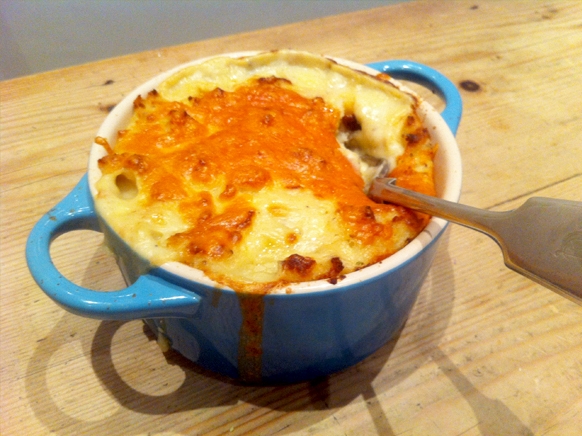
Fish Pie Pots Wholesome Seduction

Feeds 10

Ingredients

5 eggs
2 lemons, juice and zest
1.4kg potatoes: Rooster or Maris Piper both good for mashing
600g Pollack, filleted bones and skin removed
200g smoked haddock, filleted, bones and skin removed
340ml milk: I swap between soya and cow’s and no-one notices.
20g butter
3 tbsp flour: plain or rice
2 tsp Dijon mustard
60g low fat cream cheese
2 tbsp olive oil
1 dsp wholegrain mustard
250g tiger pawns
5 scallops – optional
2 tbsp parsley, chopped
120g mature cheddar, grated

Fish Pie Wholesome Seduction

Fish pie calls for a bit of pan juggling. Don’t stress about timings, it all goes into the oven at the end so there’s no roast dinner co-ordination called for.

Method

  1. Put eggs to simmer in a pan of cold water that just covers them. From the point the water begins to boil, set the timer for 6 mins.
  2. Pat fish (not shellfish) with lemon zest and put to one side.
  3. Peel potatoes and set to boil with pinch of salt.
  4. Remove the eggs and stand in cold water.
  5. Lightly poach fish in milk then turn off heat.
  6. Meanwhile, melt butter in a pan and stir in flour, slowly add milk from fish pan to make the white sauce. Add Dijon mustard and stir continuously until the sauce begins to bubble and thicken. Remove from the heat and set aside. You’ll have a little milk left over, should you need it for the mash.
  7. Pre-heat oven to 180°C and grease baking dish.
  8. Drain potatoes and return pan to a low heat to dry off – See my Mash not Smash tips for perfect creamed tatties.
  9. Add low fat cream cheese, olive oil, wholegrain mustard salt and pepper and mash. A lot. Then whisk with a fork to get lots of air in, giving you fluffy, creamy mash heaven. You may want to add the retained milk from earlier. If not, discard.
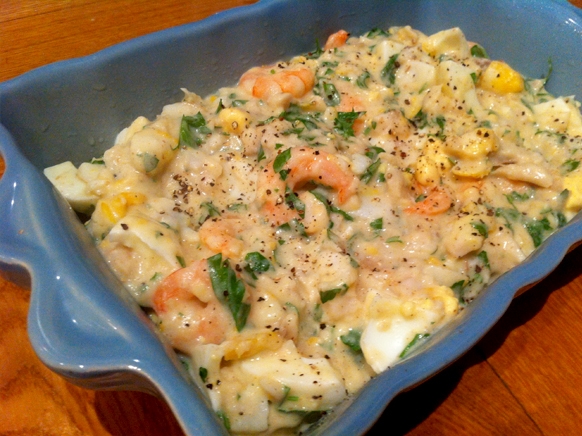
  10. Peel boiled eggs and cut into quarters. Mix with fish, shellfish and white sauce and pour into baking dish. Make sure your fish isn’t swimming in liquid, or you’ll end up with a sloppy pie.
  11. Top with mash, then grated cheese and bake in oven for 30 mins, until cheese has started to brown and sauce begins to erupt around the edges.

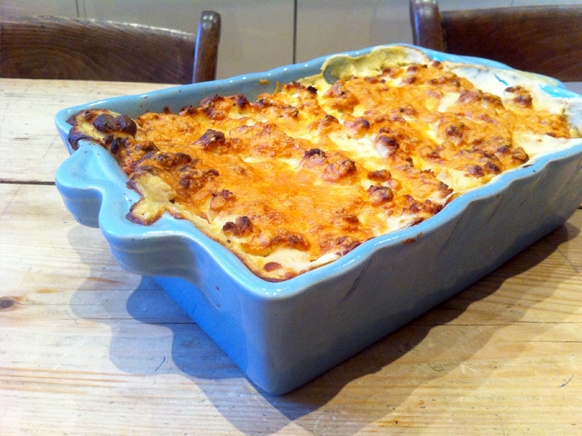
Zesty Winter Fish Pie Wholesome Seduction

Serve with green salad. Crunchy freshness with creamy pie.

PP: 385 Kcals Protein 29.5g  Carbs 32.8g OWS 2.6g  Fat 16.1g Sat Fat 7.4g Salt 1.2g


Mash not Smash

Posted in: SF, V, WF

On making my faithful old fish pie recipe, it occurred to me that perhaps my mash checklist could be considered more meticulous than most. In my defence, Root was essentially a mashed potato shop. Kind of. And my Granny was a beef farming Scot: we love our mince and tatties. Even my non cooking uncle felt compelled to bark instructions at me on the need for endless mashing and whisking as I sweated over his Aga. So, here’s my step by step guide on perfect mashed tatties.

Feeds 6 (or 4 farmer portions)

1kg potatoes: Rooster tend to lump less; and Maris Piper, a safe, readily available bet.
60g low fat cream cheese
3-4 tbsp olive oil
100ml warm, full fat milk (or cream if you prefer). I often drop all together.
Salt, lots of
Freshly ground black pepper

Method

  1. Peel potatoes and cut to similarly proportioned pieces. Quartering is generally a fair guide.
  2. Place in a large pan and just cover with cold water. Set to boil gently.
  3. After approx. 20 mins, test with a knife. You want soft right through, though not disintigrating.
  4. Drain off water and return pan to the lowest heat, ensuring all water evaporates. Dry potatoes are key if you want a fluffy, non-Smash, mash.
  5. Keeping the pan on the heat, start to mash. When you think you’re finished, go round again, working to remove all the lumps.
  6. Add cream cheese, salt and pepper and whisk with a fork.
  7. Add olive oil and milk (if using) and whisk until you feel the need to remove layers of clothing from having burned more calories than in a spin class.
  8. Taste, season, add more oil or milk if needs be. Whisk and test again.
  9. Ta dahhh!

Add wholegrain mustard, chives (added to hot milk then whisked through), lemon or frozen peas – they’ll de-frost in seconds. Potatoes go with everything so you can’t go far wrong.

Swapping the Rooster for new potatoes, skins on, and adding rosemary sea salt is my all-time favourite. Top with salmon and poached egg. Trust me. 

Note: Potatoes love salt and fat. There are times when no-one’s any the wiser if we cut out or swap the ‘baddies’, and there are times when food partners need to be respected, however waist expanding. So speeketh the Scot.

PP (6): 218 kcals Protein 3.7g Carbs 28.8g OwS 1g Fat 10.6g Sat fat 3.8g Salt 0.9g

PP (4): 328 kcals Protein 5.6g Carbs 43.3g OwS 1.5g Fat 15.9g Sat fat 5.6g Salt 1.4g


Foraging for Scottish brambles and other things

Posted in: Uncategorized

What did our grandmothers do before UK supermarkets became an abundance of year round global crops? And what does seasonal really mean when we can freeze food? OK a summer fruit salad is probably best avoided in December, but frozen berries and purees mixed in recipes are surely just as good? In fact, compared with tasteless bananas picked while green for import, the freezer wins every time, in nutrients too.

Netherton-sunset-view

Black-Isle-Rainbow,-Netherton-Farm

Although our Netherton Farm bramble hunt proved disappointing, Mother Nature turned up other surprises that our grannies, and a 1929 MAFF guide, would never have allowed go to waste.

The Ministry of Agriculture Fisheries & Food, HMSO Bulletin 21: Home Preservation of Fruit & Vegetables.

MAFF-Guide

Mother Garcia’s cherished (and sous chef crayoned) 1970’s copy talked her through jamming, canning and bottling in preparation for the winter months; and a Wholesome Seduction child is born.

Netherton Farm Foraging Finds:

Elderberries, lots of.

Elderberry-Juice-recipe

The post elderflower berry is a nutritional powerhouse. Note: they’re poisonous unless cooked. They won’t kill you, but chances are you’ll vomit them back up before any of their goodness has been absorbed.

Good for: A syrup for coughs or on ice cream; in smoothies, juices or Elderberry & Apple Jelly (jam), or just on top of yoghurt.

Too late for elderflowers, the homemade champagne will sadly have to wait till next year.

Sloes & Rosehips

Sloes-&-rosehips,-foraging

Good for: Hogmanay Sloe Gin. And Rose-hip syrup – the UK’s pre Ribena answer to Vitamin C.

Brambles & Acorns

Foraging

Good for: Bramble bircher. And feeding pigs. Look no further than Spain’s famous Pata Negra Jamón.

A (rarely seen) Fairy Ring

Fairy-Ring

Good for: Fairies. They live inside the mushroom circles.

Wild Boar cross Tamworth piglets

Netherton-Farm-piglets

Not entirely wild but in fact, largely dependent on Mum Garcia for food, and affection it would seem. Surprisingly needy mammals, pigs.

Good for: Pork belly, smoked bacon, sausages, Pork Pies, Pigs Cheeks with Apple & Cider… It really is my favourite meat.

3 weeks old

3-day-old-piglets

For the love of God! Do I really love pork belly that much? Yep, afraid so.


Curb-side Cuisine, my EP Magazine feature article

Posted in: Featured, Reviews

Street food has gone way beyond lukewarm chips and cardiac arrest kebabs. In fact, our global love affair with bin top dining appears only set to blossom. American Slider bars, churros huts and oyster shacks worthy of a Michelin star now grace everything from luxury festivals to car parks. The less salubrious the back street, the more kudos, it would seem; anything to be considered vaguely underground, guerrilla or pop-up.

ClareGarciaStreetFood

Instead of pouring gargantuan wads of cash into premiums, rents and rates, street concepts can be set up relatively speaking, with little capital outlay and reasonable pitch fees. Consequently, the mobile dining craze is increasingly a labour of love, not to mention bambinos. Passionate cooks armed with inspiration from their Gap Year, fresh faced Michelin trained chefs and multi-cultural Britain at its best: recipes as Amma made them.

GreenGoat.WholesomeSeduction

No doubt in part due to our globe-trotting nature, we Brits are more discerning than ever when it comes to our fuel, shunning sugar strand sculptures and biblically proportioned menus in favour of simple, fuss free food done well. A shift that is evident beyond the tarmac: Burger & Lobster, Byron and Mooli’s are profiting from the pared down trend. Mark Hix recently opened Tramshed, serving nothing but chicken or steak, and Shoreditch’s Chicken Shop is the brainchild of Nick Jones. Think Soho House meets KFC.

In the same ‘Too Kool for Skool’ vein, websites and glossy marketing are being shunned in favour of less static and more interactive blogs and Twitter. And the resulting word of mouth can spread like wild fire. Lucky Chip, Pitt Cue Co. and Meat Liquor started out as two-man vans, only to be propelled into The Fashionista Restaurants To Do List as a result of their Twitter fame. Oh, and the Hereford Steer beef and Dalston Tommy K, of course.

FROM THE US OF A, TO OZ, TO US.
KOGI BBQ VAN @kogibbq
Where it all began. Roy Choi launched his Mexican and Korean BBQ genius in the US. Fans, more vans and social media followed. There was no going back.

BEATBOX KITCHEN @beatboxkitchen
Rashid brought the US food truck craze to Oz.

MEAT WAGON to MEAT LIQUOR @themeatwagonuk
Yianni would pitch up his Peckham Meat Wagon and only then tweet his location. Brave? The Twitter love and consequent word of mouth proved so strong, queues were guaranteed around each South East London block. Chicken Cottage must have been up in arms. Two years on and the queues have moved to the back of Bond Street. Yianni may have taken on an exorbitant W1 lease, but he’s remained firmly on the no-booking policy bandwagon. Sorry.
Patty&Bun.WholesomeSeduction

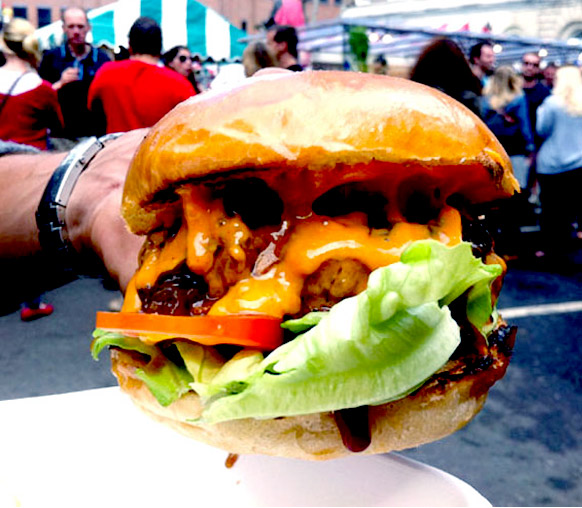
PATTY & BUN @pattyandbunjoe
Yup, another burger van – with triple cooked chips. Patty & Bun link with Street Kitchen to create gourmet pop-up clusters.

STREET KITCHEN @streetkitchen
Jun Tanaka and Mark Jankel of Pearl and Notting Hill Brasserie led the way with their British Bistro airstream and remain at the forefront, fuelling the City and London 2012. #CelebrityChefVan #100%BritishProduce #MichelinGourmet #AirstreamStyle #FoodToGo

CHURROS GARCIA @churrosgarcia1
Spanish doughnuts and chocolate dipping heaven. No relation, but just as Abuela made them all the same.
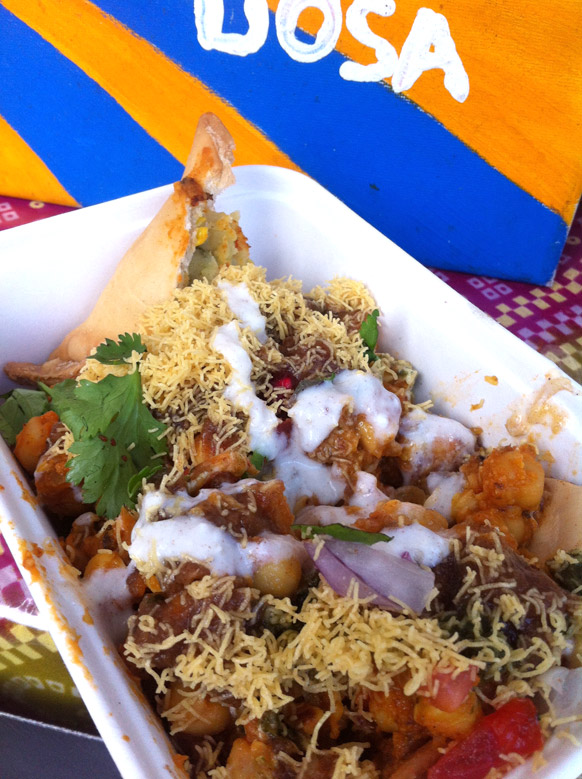
HORN OK PLEASE @Horn_Please
The genuine article. Pani puri and samosa chaat, just as you find them in India. Minus the Imodium.
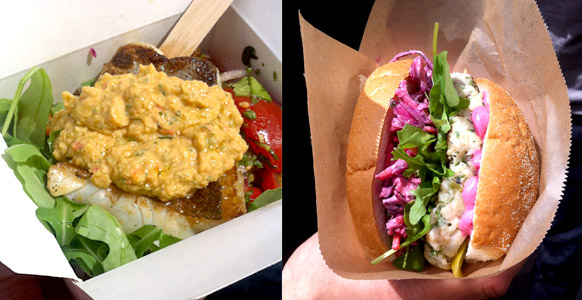
GREEN GOAT FOOD @greengoatfood Sustainable fish worthy of starched white table cloths and a hefty price tag. In a box for a fiver.

So what does this mean for retailers and food service? Take inspiration from the one or two-man operations discussed and have some fun. We live in the cultural melting pot that is Britain, do we not? Some of my favourite and simplest recipes have been passed on by families from my travels, by colleagues, by grannies or through my own Hispano-Celtic heritage. Some of the most coin-worthy café menus I’ve created have come from said list. I guarantee there’s a wealth of portable dining on your payroll.

Don’t get hung up on costumes or theme days. Most street concepts are little more than a sheltered table, two giant pots, even bigger personalities and a stack of eco-friendly take-away boxes. With smearing, wrapping and packing at lightening speed – sellers, take note!

WholesomeSedcutionCurb-sideCuisine

To be clear however, life is a beauty pageant – gastronorms of slop won’t fly. Street vendors and retailers increasingly showcase offers worthy of an art gallery. If the food is the real deal, it will speak (and smell) for itself. When all is said and done, you’re bringing nourishment and relief to the working day, enjoy it. If you feel a burning desire to promote your pop-ups via Twitter, so much the better.

This article first appeared in the October issue of EP Business in Hospitality. View the online version here: www.epmagazine.co.uk/curb-side-cuisine/

Seasonal Seducer: Sweet corn

Posted in: Uncategorized

MOST ATTRACTIVE FEATURES

Excellent quantities of antioxidants, Vitamins C, B3 and A, protein, fibre and folic acid. And it’s low GI. This old timer’s bursting with charm.

WHY WE FELL IN LOVE

Impressively, cooked corn retains its antioxidant activity and although Vit C levels diminish, folic acid actually increases – great news for fritters, soups and stir-fries.

Indispensible the world over, from South America to Spain and India to the UK. There’s a reason we’ve remained faithful to Mr Green Giant so long.

Saving the world, one recipe at a time.

Posted in: Uncategorized

There’s an awful lot of information to take in about the humble fish. We’ve trawled through it (sorry…) and we think we now have a better understanding of what’s going on.

It seems clear that things aren’t well in the underwater world. There’s more radiation, more plastic, more chemicals and more oil. The only thing that there is less of, it appears, is fish. Here in Europe, we’re fishing so fast, supplies can’t keep up. The fish can’t reproduce quickly enough to fulfil our appetites. Quite simply, the ones that make up most of our weekly supermarket buys are running out.

And the problems don’t end there. The methods we use to catch our dinner make things worse. Huge trawl nets capture more fish than they need (or are allowed to bring ashore) – and these are just thrown back. Dead. At the moment, half the fish caught in the North Sea alone is thrown back this way; with young fish making up a scarily high percentage. It doesn’t bode well for the future.

As if all this wasn’t enough, as well as catching too many, we’re often catching the ‘wrong’ sorts. ‘Fish aggregation devices’ (FADs – a kind of floating raft in the sea that certain fish (especially tuna) are attracted to), are a key example. They attract more than the tuna they are aimed at – they lure in turtles, sharks and rays too. FADs are becoming notorious for bringing in fish that are too young and so upsetting growth rates as well as for disrupting the general migration patterns.

It’s a huge story. And not one that we can tell as well is Hugh. But what we can do is talk you through the Wholesome Seduction way of being friendlier to fish, and to be honest it’s very simple.

Eat more of it!

Try out different types, rather than sticking to poor old cod, tuna and salmon. Here’s a list of some of the most plentiful fish in our oceans:

Coley, pollack, pouting, sea bass, lemon sole, gurnard and Dabs. Herring, mackerel, sardines, kippers, tilapia and whiting.

We think it’s a pretty inspiring list. Who knew that saving the world would be so tasty?

Check back on Friday for a weekend BBQ recipe for Mackerel. In the meantime, find out more about Hugh’s Fish fight.


Back to the Future, terrifying technologies & fish fights.

Posted in: Uncategorized

Returning to the UK after months in Asia, we’ve found ourselves in a science fiction story. Kindles (both of us had to ask our Mums to explain these to us), iphone 4 (with 5 on the way) and intelligent technologies that follow you around your home (did nobody else see the 1992 film, Homewrecker? No? Never mind).

Having spent months in India, where hot water and electricity were a luxury, it’s all been a little overwhelming. The western world feels like an alien place right now.

Let’s talk food (after all, this is a food blog). Our first trips to the supermarket took our breath away. We both walked around our respective local stores with our mouths slightly open, attracting nervous glances from the other customers. And it wasn’t just the prices (friends weren’t kidding when they said things had increased in the last year or so!). It was the variety that hit us most. Butternut squash and parsnips in June? Mangetout flown in from Thailand? As they say in India, ‘everything is possible!’.

And the fish. There was so much variety! Coming from a village in the Himalayas, where the only kind of fish was the sort in a tin, this was a welcome sight for Nadine. But it did get us both asking questions. Wasn’t there a problem with cod still? And swordfish, that was in danger too wasn’t it? Perhaps this modern world we’d returned too had fixed the problems, we thought…

As a girl with a little too much time on her hands, Nadine decided to investigate. Clare pointed the direction to Hugh’s Fish Fight and the mind blowing discovery that half the fish caught in the North Sea are thrown back, dead. Mum Sharkey added food for thought (sorry), with a passing comment about nuclear fish in the oceans around Japan. It crossed our minds that perhaps we’d returned to a different kind of Sci-Fi movie altogether.

But it didn’t end there. It turns out that there’s food dye in our farmed salmon. That the EU is in trouble with Greenpeace and local African fishermen for ‘stealing’ their fish, destroying their ecosystems and damaging their livelihoods. That it takes more quantities of mackerel to feed farmed fish than the farms produce in return. And that turtles and rays are under threat from tuna fishing methods.

Quite frankly, it’s a little frightening.

But at least it’s not being ignored. Everyone from Prince Charles to Elle McPherson have got involved with the Project Ocean campaign at Selfridges on London’s Oxford Street, while Stephen Fry and Richard Branston are firm supporters of Hugh’s Fish Fight. There are petitions to sign all over the place. And change is happening! Tesco and Princes have changed their tuna for a start.

All of which was a bit of a relief to find out. So, leaving the big gestures and political change to those with a bit more influence, we decided to set about finding out what little things we can do to make a difference.

Firstly, you could sign some petitions. These are a good place to start:
http://www.fishfight.net/
http://www.greenpeace.org.uk/fishfigh

Secondly, if you have a little spare cash, make a donation:
http://www.selfridges.com/en/StaticPage/ProjectOcean/#/donation

Thirdly and, in our minds most importantly, change the fish you eat. Start simply:
Cut out cod, munch on mackerel, limit yourself to line caught tuna, and make sure it’s MSC certified if possible.

Over the next few weeks, we’ll be running a series of posts on sustainable fish and fish farming to help you make your own decisions about what to eat and what to avoid. We’ll also throw in some of our favourite fish recipes.

Start now by buying MSC certified salmon and making Tamari & Sesame Wild Salmon with Purple Sprouting Broccoli.